Powered By

Free XML Skins for Blogger

Powered by Blogger

Showing posts with label B. Show all posts

Tuesday, September 29, 2009

Burns

General Info about Burns


One of the most painful injuries that one can ever experience is a burn injury. When a burn occurs to the skin, nerve endings are damaged causing the intense feelings of pain.

Burn injuries, have reached epidemic proportions in recent years and are considered a health care
problem that is more serious than the polio epidemic when it was at its peak. It has only been in the past several years that the medical profession has begun to recognize and understand the problems associated with burns. Burn accident statistics show that at least 50% of all burn accidents can be prevented. Across the world approximately 4.8 million burn injuries are reported per year. Between 18,000 and 22,000 patients with burns die, and approximately one million will sustain substantial or permanent disabilities resulting from their burn injury.

The kitchen is the most frequent area within the home where burn injuries occur for children newborn to four years in age. The second most frequent area in which burns occur is in the bathroom.

Burns can be of two kinds based on the extent of damage:

Partial Thickness Burns.
In partial thickness burns, there may be redness due to capillary dilatation but the underlying germinal layer is intact.

Full Thickness Burns.
In full thickness burns, the skin is completely destroyed.


TTPartial ThicknessTFull Thickness
DepthSuperficialDeep
SensationPresentAbsent
HealingCompleteScar And
Contractute

Bullying at School - Tips For Schools

Introduction

Bullying is an intentional, hurtful and character damaging act by one individual or a group of individuals on other individual or group of individuals.


Bullying today is a societal menace and draws the attention of parents, teachers and sometimes education authorities. It can take the form of -

* Beating

* Kicking

* Name calling

* Excluding from peer group

* Insulting in public places

* Taunting

* Playing hurtful pranks

* Damaging belongings

Bullying in schools is a universal problem. The severity of the problem may vary from school to school. In recent years, the constant media attention has made bullying a global issue. Many schools have been forced to evaluate their teaching methods and add new policies on anti-bullying behavior.

Over thirty years of my experience in working with school children as a teacher and then as a principal, I have found many schools often deny the presence of bullying in their campus. However, denying the presence of a problem does not mean it’s not there. School authorities have often also been found to blame the current social structure. Some of these are:

* Working parents

* Unstable homes

* An increase in divorce rates

* And abuse at home

The above reasons definitely do create a volatile environment for the child and on many occasions does play a vital factor in the child’s psychology and behavioral patterns. Nonetheless, some stability needs to be brought in and only through a consistent effort of schools, government and parents can bullying be controlled.

Personally I feel that, youngsters often miss essential basic values, respect for themselves and others, humanity, love, tolerance and confidence. They spend much of their time on the Internet or watching television that does not help them learn or build on positive social behavior. In the recent years we have found that with every new batch of children, we have youngsters who are becoming increasingly aggressive and exhibit gross misbehavior. Hence there is considerable increase in the kind of bullying and its severity. The ratio of bullies to bullied is one is to ten, in the recent years

Bullying at School - Tips For Parents

About Bullying behavior


The murder of a schoolboy, Abhishek Tyagi by his classmates in the Euro International School in Gurgaon, Haryana, India, on 11 December 2007, shook a nation that was hitherto complacent about the lethal aspects of the bullying menace. Apart from the extensive media coverage, there were heated debates among parents, teachers, children and the general public. The alleged reason for Tyagi’s murder by his schoolmates in the school corridor: Tyagi was a bully.


Might is not always right

Having a fight in school may be part of growing up, but it takes an ugly turn when it assumes serious proportions. Bullying can happen anywhere when human beings interact with each other.

Schools and play areas make excellent breeding grounds for bullying in the case of children. Parents can contribute in a great way to put an end to this worldwide menace. They need to be aware that this is happening and keep constantly honing their parental skills to deal effectively with their bullying /bullied children. They can work in collaboration with school authorities, counselors and psychologists and involve the child’s siblings, if any, to instill firmly in the child’s mind that might is not always right.

Bullying behavior

A bullying tendency that is left unchecked in the earlier years of life, escalates to typical bullying behavior that includes being intentionally hurting, verbally abusive, mocking, threatening, extorting, ridiculing about appearance or lack of talent, all of which can cause considerable damage to the victim at the physical, psychological and emotional levels. Most bullies find it difficult to toe the line after the initial bout of success while teasing an unfortunate victim.

Fatal Bullying

Bullying can sometimes have violent consequences when the victims are driven to taking a gun in hand. On 24 January 1989, two students were fatally shot down by a fourteen-year-old student who claimed to be a victim of bullying at the Raumanmeri secondary school in Rauma, Finland. Brian Head, a teenaged student
from Georgia, shot himself dead in his economics classroom on March 26,1994, allegedly a target of bullies because of his weight and thick glasses. Eyewitnesses said, Brian’s last words before killing himself were, “I’m tired of it.” Brian’s father lobbied hard for the enactment of a law for criminalizing bullying and for schools to alert parents of bullied children.

Child bully now, adult bully next

Research has linked bullies to aggressive personalities. They are most often authoritarian with an urge to control or dominate others. Envy and resentment are also known motives for bullying. A bullying tendency has the danger of mutating as the child grows into an adult and begins to be controlling and manipulative in relationships.

Aggression is not assertion

Most parents are unable to differentiate between an assertive child and an aggressive child. In their desire to see their children become independent and capable of fending for themselves, parents fail to notice when assertion becomes aggression. On 29 January 1979 16-year-old Brenda Ann Spencer carried out a shooting spree in Cleveland Elementary school, San Diego, California, with a .22 rifle that her dad had gifted her, wounding 8 children, a police officer and killing 2 adults, one of whom was the school principal. She did it to liven up the day, because, “I don’t like Mondays,” she said. Her infamous statement prompted a song
by Bob Geldof that topped UK charts and was even performed later by the likes of Bon Jovi.

Bulimia Nervosa

Bulimia Nervosa - Overview


"In 30 patients whose illness bears a close resemblance to anorexia nervosa,…episodes of overeating constituted the most constant feature of the disorder…. Overeating was often overshadowed by more dramatic clinical phenomena--intractable self-induced vomiting or purgation…. The constancy and significance of overeating invite a new terminology for description of this symptom--bulimia nervosa."

- Gerald F.M. Russell, 1979


The term 'Bulimia' refers to episodes of uncontrolled excessive eating, known as "binges," followed by self-induced vomiting or purgation. It commonly occurs in adolescent girls. The key elements include the following

This 'Eating Disorder' is characterised by an irresistible urge to overeat.

Extreme measures to control body weight and misconceptions regarding the "perfect" shape and size of the body are observed, similar to that in patients with Anorexia Nervosa.

The condition might get severe with huge quantities of food being consumed.

To prevent weight gain patients resort to self-induced vomiting, abuse of laxatives, fasting or extremely rigorous exercising.

Bubbles and Brews - Alcohol Facts

About Alcohol


There is more to alcohol than mere intoxication. Infamous because of its social abuse but indispensable because of its many industrial applications. The process of fermentation obtains an alcohol.

Alcoholic drinks are widely popular and an essential element for socializing and relaxation - it is said the ingredients of man's happiness include - wine, women and mirth. Ethanol is the alcohol present in alcoholic drinks. Their excess uses lead to several social and health problems.

"He that drinks fast pays slow." Benjamin Franklin

The production and consumption of alcohol is part of most cultures and societies around the world. Drinking alcohol is an important social event among hunting tribes and civilized nations alike and may be closely associated to the culture of a community.

'Alcohol is the anesthesia by which we endure the operation of life.' - George Bernard Shaw

In early and modern cultures, alcoholic beverages have played a vital role in social interaction by providing confidence and removing inhibition. While several psychoactive drugs such as opium and cannabis have the same effect they are not as socially accepted as alcohol.


Uses of Alcohol

In the olden times various reasons are attributed to the usage of alcohol such as-

* Therapeutic

* Recreational

* Relaxation and feeling of euphoria

* Aphrodisciac (modern studies have proved that this notion is false)

* Inspiration for creativity

* Religion

With time alcohol was found to be a very useful solvent and as an energy source for industrial use. Today alcohol finds a place as an important substance in many Industrial and pharmaceuticals manufacturing processes.

* An alcohol is used as solvent to dissolve medical drugs, perfumes and essences like vanilla.

* Both methanol and ethanol are used as fuel for automobiles. In comparison to gasoline they burn cleanly producing only carbon dioxide and water.

* It is used as a preservative for specimen storage in laboratories and museums.

* Ethanol has been used as an antiseptic to disinfect the skin before injections. It is used for making soap with disinfectant properties. It is also used for cleaning paint- brushes.

Bruxism / Tooth Grinding / Jaw Clenching / Teeth Clenching / Parasomnia

Bruxism - Overview


Bruxism is the unconscious clenching or grinding of teeth, during sleep. Nocturnal teeth grinding is one of the most common sleep disorders.

"The smith's dog sleeps at the noise of the hammer, and wakes at the grinding of teeth." - Unknown

Bruxism comes from the Greek word "brychein," which means 'to gnash the teeth'. It can cause enough noise to disturb the bed partner's sleep.

On an average, bruxism occurs about 25 times a night, with each episode lasting anywhere between four to five-seconds. In some cases, people with bruxism may grind their teeth for more than two minutes.


Sleep bruxism may go unnoticed when it is in a mild form, which may not warrant treatment. Victims wake up to the problem only in the midst of complications which could manifest as jaw problems, headaches or injury to the teeth.

Awareness about the condition is important; Corrective dental care could remedy the problem to a great extent.

Colle’s Fracture / Broken Wrist

About


Colle's fracture is a wrist fracture which occurs within an inch of the wrist joint involving the forearm bone's distal end of the radius. The fracture runs transversely just above the wrist joint and displays this distal end of the bone more dorsally giving the wrist the classical 'dinner fork' deformity look.


Colle's fracture is named after Abraham Colles, an Irish surgeon, who first described the condition. Another name for this fracture is the 'Pouteau' fracture. It mostly results from a 'slip and fall' on an outstretched hand.

Usually the incidence goes up after the rains or after the first snow fall in winter when the roads are icy and slippery or. Typically, when people fall they try and prevent injury to their head or other parts of the body by putting their hands out to hit the ground first. A bad fall results in fracture of the wrist with bruise of the skin over it. As the bone is a living hard tissue it is supplied by blood vessels and nerves. This causes the fracture to be very painful.


Although this fracture occurs in all age groups it tends to be more common in two age groups - the elderly people and in children. In Children the bones are soft and supple and hence tend to bend easily. Here the fracture is usually incomplete while in adults it is a complete fracture. These fractures are also seen in menopausal women with osteoporosis, in whom it is second only to vertebral fractures.

Wrist arthritis can occur as a Colles fracture complication, either from cartilage injury, or from wear and tear in the joints after the fracture is healed. Carpel tunnel syndrome, characterized by numbness and tingling, may also set in after the fracture.

Breech Presentation and Delivery

Breech Presentation and Delivery - About


Breech presentation during pregnancy means that the buttocks of the fetus are presenting first at the bottom of the uterus, and the head is in the upper part or fundus of the uterus. The uterus is shaped rather like an upside-down pear, so the baby's head fits in the lower part, with more room at the top for movement of the extremities. As the baby grows, the uterus gets more crowded and it is most common for it to assume the head -down presentation. Generally, the placenta is attached at the side of the uterus, which seems to encourage the head-down presentation, too. There are a number of variations of the breech presentation, determined by the position of the baby's body parts, like arms and legs, in relation to his or her head and trunk. They are -


* Frank breech (50-70%) - Hips flexed, knees extended with the feet near the face (pike position)
* Complete breech (5-10%) - Hips flexed, knees flexed (cannonball position)
* Footling or incomplete (10-30%) - One or both hips extended, foot presenting
* Kneeling breech - the baby
is in a kneeling position, with one or both legs extended at the hips and flexed at the knees. This is extremely rare.


Breasts - Structures and Types

About Breast

"Thy two breasts are like two young roes that are twins, which feed among the lilies." Bible quotes


Anatomically breasts are quite literally two well structured and shaped mounds of fat that start to grow on the chest of girls when they hit puberty. The biological objective for women to have breasts is to eventually produce milk to wean her baby. Breast growth can be noticed in some girls as early as age 7 or 8, while in others it does not start until their late teens or even early 20’s.

Scientifically there is no way of knowing how big or small or how fast or slowly they will develop or when a woman’s breasts will start to grow.

It is however believed that the timing of these developments is associated with ones own biologic clock, which tells our body to start producing the required levels of female hormones called estrogen. From the moment the ovaries start to secrete these hormones, the connective tissues in the chest start to accumulate fat. This causes the first appearance of breasts on the chest wall of girls. The duct system in the breasts also begins to grow; these are what will eventually help to produce milk for the expecting mother.
Usually the first signs of puberty in most girls are associated with the development of the breast. Along with this, one can often expect the onset of pubic hair and hair of the arm pit.

The final size and shape of a girl’s breast varies greatly from being big breast, small breast or even perfect size breast. These pointers are all determined by the heredity of the girl.

Breasts from time immemorial have been the icon of a women’s beauty. They give the women the personality, make them often desirable and have always fascinated their male partner.

Over the years people have referred to breasts by various terms; however it is the slang that is more popular. Some common slangs are: Tits, Titties, Norks, Jugs, Knockers, Bust, Boobs, Bosoms, Boobies, Baps, Bust, Hooters and Melons.

To fully understand the developments of the breasts it is necessary to first look at the structure of the breasts.

Breast Reduction Surgery

Breast Reduction Surgery


Want firm and shapely breasts? Consider the option of traveling abroad to have it done at affordable prices.

Breast reduction is a surgical procedure carried out to minimize the size of breasts.

Also called reduction mammoplasty, this procedure is largely carried out on self-conscious women with pendulous, large- sized breasts. Besides the aesthetic aspect, the weight of these breasts may cause chronic pain in the head, neck, shoulders and back besides causing problems in circulation and breathing.

Breast reduction is also carried out on women with drooping or disproportionate breasts and on men with gynecomastia.

Breast Reduction is an out- patient surgery done under anesthesia. It involves the removal of excessive skin, fat and glandular tissue. Markings are made on the breasts after which incisions are created. Excess skin, tissues and fat will then be removed. Due to the reduction in size, the nipples may have to be repositioned.

This procedure is hugely popular among women as it results in smaller, firmer and shapely breasts. Male patients too,with gynecomastia, have their confidence restored.

Some of the common risks include difficulty in breast feeding, delayed wound healing, infection,pain, scarring and asymmetrical breasts. There could be permanent scarring from this procedure,but this could be made inconspicuous by an expert surgeon.

Are you self-conscious about your breasts? Would you like to make your life more manageable, free from back and neck pain?

If you have plans to travel abroad for an affordable breast reduction surgery, we suggest that you check out the credentials of the plastic surgeon and the hospital or consult us first to help you.

Breast Lumps-Screening

About


Breast lumps must never be neglected but instead be subjected to medical examination to rule out cancer
.
Breast lumps are common enough in women of all ages and may be caused by injuries, infections, non-malignant growth or cancer.

Routine breast cancer screening is carried out usually in healthy women above the age of 40 years with intent of detecting breast cancer even before the lumps appear.

Breast cancer deaths have declined in several parts of the world due to early detection and efficient treatment methodologies.

Once a breast lump appears it must not be neglected but subjected to medical examination to rule out cancer.

A breast lump is evaluated by taking the medical and family history of the patient, which is then followed by a physical examination. The risk factors associated with the patient are also observed.

Mammograms and breast scans are reliable screening tools.

In case of a family history genetic tests and breast MRI are also recommended.

Self-examination is not aggressively encouraged, as it tends to detect the cancer at a more advanced stage. The American Cancer Society now recommends it as a choice that can be exercised after the mandatory mammogram.

Breast Lumps

About


Do not neglect any breast lump. If you discover one - make a visit to your doctor.

An appearance of breast lump can be a cause of great anxiety to women whether young or old. A 'lump' is a three-dimensional discrete mass which is distinct from surrounding breast tissue.

Some women just ignore these lumps despite suspecting them to be malignant. The general thinking is 'it can't happen to me.' While it is true that majority of breast lumps are benign in nature, about 16 to 20% maybe malignant. In the medical faternity the dictum is to treat all lumps when they first present as malignant unless proven otherwise by tests such as ultrasound
or aspiration.

If in your case the lump does, unfortunately, turn out to be malignant - rememeber that there is a 'small window period' during which all early cancer are totally curable.

Our advise to you would be - DO NOT NEGLECT ANY LUMPS. Seeing your doctor is the first step you should take. Postponing this decision could make the difference - between living and dying.

Most common causes of Breast Lumps include: -

1) Fibroadenoma

2) Fibroadenosis

3) Breast Cyst

4) Breast Abscess

5) Breast Cancer

Breast Feeding and Problems

Directions for Breast Feeding

Good Health begins with mother.There is no substitute to her milk.


Most of the babies
come into the world knowing how to be breast-fed. If you get them anywhere close, they nuzzle, get attached, and suck away. Some need a little assistance.

To breast feed properly, your baby needs to open its mouth wide enough to take in the nipple and about a centimeter or two of the breast beyond it.

Your free hand should be used to support your breast, keep it in the baby's mouth, and keep it out of the baby's nose. Use your fingers under the breast with your thumb on the top.

Hold the baby at your breast by positioning it on its side or tummy-to-your tummy with its mouth at nipple level. During the first breast feedings, it is often helpful to remove the upper clothing from both mother and baby to be skin-to-skin.

To help the baby get started, express the milk into its mouth. This encourages the baby to open wide, suck, and swallow.

As a general rule, you'll breast feed your newborn eight to twelve times per day. Breast-feed your baby on demand, not by the clock. You don't want to let your baby get overtly hungry, as it does not feed well if you do so.

Sucking does not equal eating. Check to see if your baby, who is sucking away furiously, is actually swallowing. Babies usually do some sucking to swallow the saliva.

Newborns usually suck one to three times, and then swallow. Thus a new born who is sucking 15 minutes per breast, but not swallowing, is not receiving enough feeds and may need to breast feed 20 to 25 minutes per breast to get enough milk. The more the baby breast-feeds, the more milk your body will produce. Newborn babies breast feed about every two hours. However, they often breast feed for many reasons other than hunger. Therefore, allow the newborn to breast-feed as often as he or she wishes. Make sure the baby is sucking effectively. Offer both breasts at each feeding. Your baby's nose may be touching your breast during nursing. Babies' noses are designed to allow air to get in and out in such a case. But if you're concerned that your baby can't breathe easily, you can gently press down on your breast near your baby's nose to give him or her enough room to breathe.


Feeding her baby is a lifetime experience for a woman and there is no substitute for the mother's milk to the child. This is one of the most beautiful periods in the life for both the mother and child where the bond for each other develops. Breast feeding not only develops a baby into a healthy human being, but also contributes greatly to the mental development. In this feature, an attempt is made to make the expectant mother understand the various aspects of breast-feeding and its importance

Breast Feeding


To help the baby get started, express the milk into its mouth. This encourages the baby to open wide, suck, and swallow.

As a general rule, you'll breast feed your newborn eight to twelve times per day. Breast-feed your baby on demand, not by the clock. You don't want to let your baby get overtly hungry, as it does not feed well if you do so.

Sucking does not equal eating. Check to see if your baby, who is sucking away furiously, is actually swallowing. Babies usually do some sucking to swallow the saliva.

Newborns usually suck one to three times, and then swallow. Thus a new born who is sucking 15 minutes per breast, but not swallowing, is not receiving enough feeds and may need to breast feed 20 to 25 minutes per breast to get enough milk. The more the baby breast-feeds, the more milk your body will produce. Newborn babies breast feed about every two hours. However, they often breast feed for many reasons other than hunger. Therefore, allow the newborn to breast-feed as often as he or she wishes. Make sure the baby is sucking effectively. Offer both breasts at each feeding. Your baby's nose may be touching your breast during nursing. Babies' noses are designed to allow air to get in and out in such a case. But if you're concerned that your baby can't breathe easily, you can gently press down on your breast near your baby's nose to give him or her enough room to breathe.

Breast Cancer / Carcinoma of the Breast

About


Breast cancer, as the name suggests, is a cancer that affects the breasts or mammary glands.

It is the second most popular cancer after lung cancer and is the fifth most common cause of cancer deaths world wide.


On a global scale breast cancer is the most common cancer amongst women . According to estimates, in the 2004 alone breast cancer caused 519,000 deaths worldwide.

Breast cancer incidence increases with age; the older the woman, the more aggressive the evaluation techniques employed. Nevertheless, younger women with breast lumps are at a far greater risk for breast cancer in comparison to asymptomatic women of the same age group, and to older women.

Breast cancer mostly occurs in women over the age of 50, and the risk is especially high for women over age 60.

Contrary to popular belief that it is a woman’s affliction, it can affect both men and women.

A combination of enviornmental factors and genes are responsible for this cancer. In familial breast cancers. a mutation in the genes BRCA1 and BRCA2 play a major role in the disease onset.

Breast cancer can be inherited both from either a female or a male relative who may have had the disease or who acts as a carrier of the mutant gene(s).

Breast cancer incidence varies vastly worldwide. It is significantly higher in the developed countries of the world in comparison to the less-developed ones. There has been a surge in the number of affected individals since the 1970s and experts are of the opinion that the indulgent lifestyles of the western world could be largely responsible.

Breast cancer is also found to occur more often in white women than African American or Asian women. Several studies have revealed that the breast cancer scenario in the US is quite different for a for a black women in comparison to her white counterpart. The former is more likely to die from the disease although it is the latter who is more frequently diagnosed with the disease. This. experts say. is a reflection of the socio-economic and cultural disparity that exists among the races and that it is highly likely that the black woman has less access to screening and treatment facilities.

Breast lumps need to be taken seriously because the vast majority of breast cancers are detected as a palpable lesions sometimes by the clinician during a regular check or by the patient herself.It can also present as non palpable lesions during a routine mammography.It must be noted that the palpable lesions are assessed quite differently from the non -palpable lesions.

Breast cancer is one of the oldest cancers known to man. However, it is only with the modern understanding of the systemic nature disease that effective treatments began to evolve.

A pink ribbon denotes the struggle of the sufferers when fighting the cancer. In 1996 the pink and blue ribbon was designed to create awareness of the fact that "Men Get Breast Cancer Too!”

Breast Cancer - Facts

• Breast cancer is 100 times more frequent in women in comparison to men. Prognosis is the same in both.

• Most common cancer in women - the incidence rate among females is twice as much as that of colorectal cancer and cervical cancer
and approximately three times that of lung cancer


• Globally, the incidence of breast cancer is the highest among American women.

• 16% of women between the age of 40-60 years have breast-related problems. Of these 40% complain of breast lumps

• In women over 40 years, these breast lumps may carry a risk of breast cancer

• However, the majority of these breast- related complaints may be due to benign breast disease.

Breast Biopsy

Indications for Breast


Breast biopsy involves removing a sample of breast tissue to determine whether it is cancerous or benign (non-cancerous).

Breast abnormality can be detected by Physical examination, Mammography, Ultrasound and other breast imaging methods.


Biopsy followed by Pathological (Microscopic) examination of breast tissue is the only definitive way to determine the Cancer Pathology.

"It is estimated that over 48 million mammograms are performed each year and that less than one million of them (less than 5%) are recalled to undergo a biopsy"

Breast Augmentation

Breast Augmentation

Breast augmentation, breast enlargement or augmentation mammoplasty is a surgery done to enhance the size of a woman’s breasts. In this procedure a breast implant is used as prosthesis to enlarge the breasts for cosmetic purposes. It can also be done as part of a breast reconstruction (mastectomy) or a ‘sex change’ surgery.

Breast implants are of two types; silicone gel- filled or saline-filled implants
are the most popular ones. Different types of incisions are made to place the implants. The implants are placed in locations associated with the pectoralis major muscle.

The patients may be required to rest depending on the type of surgery. In general they may be able to restore normal activities within a week’s time. It is important not to strain the body during recovery. The scars due to the surgery may last for more than 6 weeks and may begin to fade only after several months of the surgery.

During initial recovery, it is important not to use the arms or strain the body in any way. Scars from a breast augmentation surgery will last six weeks or longer and usually begin to fade several months after surgery.

Infection, breast pain, change in nipple sensation and difficulty in breast feeding, are some of the complications that are asociated with this surgery. Women who have done breast augmentation surgeries may be required to do a repeat or a revision surgery to sustain the good results.

If you have lost sleep over the size of your breasts then wake up to breast enlargement!

There are many palstic surgeons and hospitals in India
doing commendable ‘boob jobs’. Check out their credentials or consult us first to help you.

Brain Tumor

General Info About Brain Tumor

Brain is one of the largest and complex organs in the human body and weighs about 1.3 Kgs. Neurons and glial cells are the basic units that make up the brain. There are about 40 billion nerve cells, known as neurons, in the brain. Brain controls our body, receives, analyzes and stores information. It produces electrical signals, which, together with chemical reactions
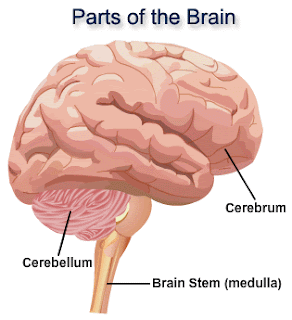
, helps in the communication of the different parts of the body. The brain has three main parts: the cerebrum, the cerebellum, and the brain stem (medulla).


Blood vessels (arteries, capillaries, and veins) supply the brain with oxygen and nourishment, and remove waste products. The cranium (the top of the skull) surrounds and protects the brain. Cerebrospinal fluid (CSF) is a clear, watery liquid that surrounds the brain and cushions it from jolts.

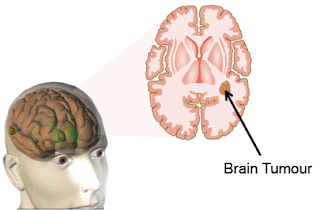
The neurons in the brain divide rapidly till about 7 years of age. Further development is by the existing cells making increasingly elaborate connections with each other.When this control is lost in a single cell, then it starts dividing in an uncontrolled manner. As the cell makes more and more copies of itself, it grows to form a tumor. A brain cancer can arise from any of the cells, which makes up the brain.

Head Injury / Brain Injury

Head Injury- An Overview

Head injury or traumatic brain injury (TBI) occurs due to sudden trauma to the head or brain, resulting in brain damage. It is the leading cause for disability among children and young adults. Although traumatic head injury can affect people of all ages, young adults between the age of 15 and 24 years and those above 75 years face an increased risk of head injury.


The Brain Injury Association of America adopted the following definition of TBI in the year 1986 - 'Traumatic brain injury is an insult to the brain, not of a degenerative or congenital nature but caused by an external physical force, that may produce a diminished or altered state of consciousness, which results in an impairment of cognitive abilities or physical functioning. It can also result in the disturbance of behavioral or emotional functioning. These impairments may be either temporary or permanent and cause partial or total functional disability or psychosocial maladjustment'.

"Phineas Gage, a 25 year old, railway construction man was a quiet, well mannered, enthusiastic young man in pursuit of his dreams, until it all happened in 1848. The worker was busy packing an explosive powder into a packing rod (tamping iron), when a spark resulted in explosion, propelling the pointed rod (3-foo long) through his head. Just within a few seconds, the rod had penetrated his brain through the skull to exit the same by his temple. Dr. John Harlow who treated the victim for 73 days felt that he had very little chances of survival. To the surprise of the treating physicians, he survived the accident. However, became an obstinate, obscene, self-absorbed man following the accident. He continued to suffer from similar behavioral and personality problems until his death in 1861. "

This incident took place at a time when very little was known about the brain and it's function. Today, with our improved understanding of the brain anatomy and physiology, we are much more equipped to deal with traumatic brain injury. Yet a considerable number of people continue to lose their lives and survivors are left to suffer from devasting consequences.
The Human Brain


Every year, approximately 1.4 million people experience a head injury, out of which about 50, 000 individuals die. More than 230, 000 people, admitted each year in the hospital for TBI, survive the disaster and are left to cope up with different aspects of physical and mental stability. The following figure represents the magnitude of the public health problem only in the United States. The depth of the global burden then? We leave it to your imagination.

BOTOX: The Magic Toxin

Overview

Botox injections are the fastest growing cosmetic procedure and considered as the ultimate fountain of eternal youth. Though considered a dangerous neurotoxin, when injected in miniscule amounts, it can treat several medical conditions.


"A thing of beauty is a joy for ever,
Its loveliness increases, it will never
Pass into nothingness"

Wrote John Keats in his epic poem 'Endymion'.

But a lot of ordinary mortals, whose ideas of romanticism do not match the poet's, beg to disagree.

Socrates could not have been more apt when he said that 'Beauty is a short-lived tyranny', as we well know that beauty and youth go hand-in-hand.

Although with the changing trends, the concept of inner beauty and grace is fast catching up giving age a fair chance, retaining or regaining skin- deep beauty in all its youthful glory is too tempting for those in the twilight zone of their youth. This is where cosmetic procedures have stepped in to cater to the needy, and Botox is one such youth-enhancing procedure.

"Always remember that true beauty comes from within - from within bottles, jars, compacts, and tubes"- Peter's Almanac

Bone Marrow Biopsy

What is Bone Marrow?

Bone Marrow is the tissue present inside our long bones, which are responsible for producing blood cells. It contains stem cells, the base for producing red blood cells, white blood cells, platelets and other blood components.